hifi

I’ve got the other place (here or here) for random ill-thought musings. But today I decided to put one here. Hi-Fi

< vaguely interesting background story with slight element of personal touch>

I left University in 1999. Having been in full time work before I had even finished my last term, and living in cheap shared accommodation, I could splash out. But being somewhat conservative (small ‘c’, you see that? SMALL ‘C’. I mean ‘c’. Just want us to be clear on this ok) I waited a year, before buying the hi-fi I had seen and desperatly wanted for a massive £280.

Now, should you have been looking at purchasing a stereo/hi-fi (what do we call them nowadays?) around this time, which I was, clearly, then you will be aware at just how vile they all were. Bulging like their biceps were about to explode (pendants will argue about their lack of biceps). The one pictured below is quite a modest example, laziness stopped my from finding a more accurate example.

The issue was not was not that these existed, I can understand there is a market for them, just like there is one for JD Sport. But that they dominated the market so. Walk in to a Comet or Currys and aisle after aisle was full of them. If they had 30 models on display then only one would be purchasable by sane persons.

[an aside: it looks like with the demise of (a) vinyl (b) tapes (c) club culture that design has moved on and most hifi’s on sale today have completely different dimensions. A good example is this from Onkyo, which is excellent and recommended]

But I had found one that was above all this, minimalistic in design, always good in my book, and stunning on the glass and wood stand it was displayed on where I first saw it (which was Dixons, yes I know). It was the Pioneer NS-9.
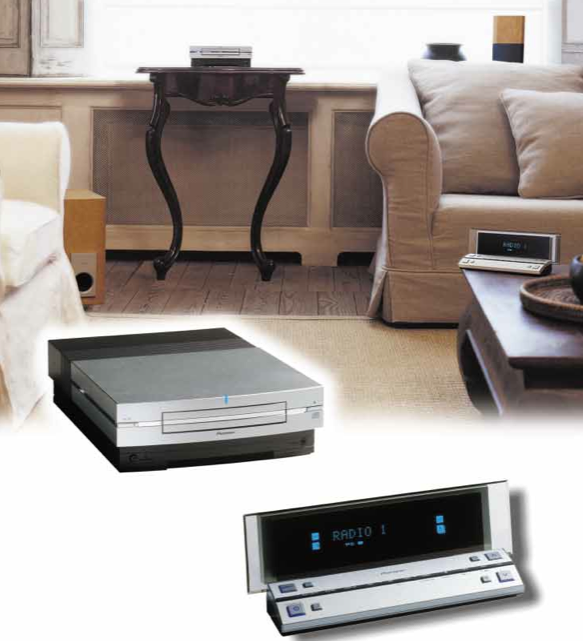
It consisted of one small unit, which was basically the hifi, a separate display, two small speakers and a woofer. It looked and sounded great. The front of the display – with all the buttons – could actually come off and act as a remote but this was more or less unworkable. The UI was awful, trying to set sleep mode or retune a preset radio setting still requires the manual.

The two small speakers and a bass combination was unusual and worked well. My flat mates and near neighbours through the years will attest to the kick arse bass it produced (literally as I type this, Open Up from Leftfield is playing).

It was the first, and still inexcusably very rare, system with FM/RDS I saw that showed not just radio station name but extended information, such as a the show, DJ, and maybe even the song that was playing, depending what the station sent out. This was way before DAB radio, and at the time at most you would normally see was the station name. I must have been one of the few reading the text that was being transmitted. I remember the Radio 1 Top 40 would show the song name and artist (and position in the chart)  which sometimes was displayed before the song was announced on air. It was if I was tapping in to some secret message no one else had access to.

Anyway, apart from the woofer, separate display and extra programme information, it was just a hifi, I still can’t quite believe I’m writing a post about it.

<finally getting around to the point of the post>

But I’m not writing about it.

For years I’ve been glancing an eye at a Hi-Fi separates system. Now isn’t the time for me to be buying one having just bought a property, but I’ve been keeping a look out for something that can replace my stereo. The CD player isn’t what it once was, and a few other niggles remain.

It started when I was a kid. I had a Matsui (Dixon’s home brand, made in Wales I think, but with a reassuring foreign name) cheap hifi. Why would anyone pay anymore than this? I can turn it up and the treble sounds high and the bass is low. It all sounds clear. What more could you want? One day, on a “I need to get out the house on a Saturday but I don’t know what to do so I’ll go to HMV and look at all the albums I could buy, again” I was in, well, HMV and Blue Monday came on. This was a time when HMV was a music shop that sold a few movies in the corner. Their sound system was amazing. I didn’t know what they all did but the black boxes when from floor to ceiling.

The song blew me away. Consumed me. Took me over. And I had it at home! I walked back to my parents house and put it straight on. It didn’t give me the same feeling. That was when I realised what a good sound system could do. And though the sound my system made sounded ‘ok’ it just didn’t have that magic. It sounded flat.

But how often do I use the CD player now? Not enough. Spotify more than anything dominates now. This isn’t always healthy. I can never settle on just playing an album, and spend forever playing favourite tracks. Anything that doesn’t grab my attention is skipped. And I know this is bad.

With audiophiles preaching about the importance of cable, good source, good amp, etc, this all goes to pot when your source is a live streaming free Spotify (subscribers get higher bit rate) going through your Macbook Pro headphone socket. So here’s the question. In this age of Spotify and similar, is the hi-fi stack still valid? I use my Hi-fi more for radio then I do CDs, yet the radio turner is often seen as an afterthought. And what about all in one compact systems, from good names such as Onyko, Cambridge Audio, Denon, Marantz, are separates really that much better than these?

One issue was the tuner, CD players and Amps start at around £100 (though it’s made clear these are bottom of the range). The cheapest tuner is £150, and that has bad reviews, and can’t do DAB+ (DAB+ is a major improvement over DAB, not man realise that the iplayer has a higher quality stream than DAB, with the possible exception of Radio 3). This is an odd situation. You can buy a decent all-in-one unit for say £200, yet a semi-decent turner separate costs about the same, but with probably less features. With the tuner on top of the CD and Amp you’re look at £350 for the most basic of basic systems, extra for the speakers. Is it worth it? How much of that expense goes on the physically boxes and extra overheads of a separates system? The reviews all make somewhat patronising comments ‘excellent sound – for a all-in-one system’, ‘good if you need a basic set in another room’ etc. But how much is snobbishness and how much is fact. Is it worth it?

So I can’t afford a new system. And not even sure I need one based on most of my listening is of Spotify, iplayer and radio 4. But I can’t decide that if I were buying a new system, which I’m not, whether I would buy an all-in-one system (such as this or this) or separates.

I’ll continue to debate what I wont be buying, but might buy if I could afford it, and update you if need be. But I still am not sure such things are needed especially as we move towards the internet/computer being the key source of music, and the main output of which is currently a crappy tiny headphone socket. If we want to hear good quality music via our computer a different route my need to be developed.

Personal URL shortener

Back in 2009 I wrote a post about creating my own url shortener. I didn’t get very far, partly due to the challenge of how to create the short url codes, and partly due to my development philosophy of having an idea, musing about it, and never getting anywhere with it. Though I did install some code Ben Charlton has written and set it up as u.nostuff.org.

Part of the drive to do this was a bizarre feeling of guilt when using ‘short urls’ from the main shortener services. Each short url I created would mean we – as a userbase – were one step closer to the URLs being one digit longer (i.e. when that service ran out of free letter/number combinations with the current number of digits). Short urls were a scarce good. Did I really need this short URL? Worse, useful services such as twitterfeed use a short url each time they add something to twitter, even if most of those links would never be followed.

However there should be no need for all of us to be using the same small set of url shorteners, if we used our own, or one for a particular group of people, or for a particular service, then we would be free to use them as we pleased. What we (internet users at large, and especially twitter users) needed was lots of URL shorteners, each able to produce short codes.

Back in April this year I came across YOURLS, an open source simple URL shortener you can install on to your site [main website | blog with new releases | Google code]. This fitted the bill exactly. Installing it was easy on my dreamhost account.

Now I just needed the short domain name. I came up with a few catchy/clever domain names, but quickly found that two digit domains were pricey or just not allowed for purchasing. especially those such as .im, ly etc.

It would have to be three digits, and if I couldn’t get or afford ‘catchy’ why not just go for something completely random? After all I just needed to remember it.

I also decided that I would buy from my existing domain name provider, rather than signing up with another organisation, especailly some of the dodgy looking ones providing sole access to unusual country top level domain names.. I also wanted to use a country that was stable and unlikely to be awkward with renewing the domain or changing the rules (sn.im didn’t work for a while while the owners argued with the Isle of Man registrar). Using 123reg, at the time the cheapest three digit domains were to be found  (amongst a couple of others) in Belgium, .be. The only concern being as the two halves of Belgium seem to drift further apart from each other, there is even talk of one day Belgium splitting up (and I bet they wouldn’t even think if my domain name during the split, well I really).

So I ended up with xd5.be. No good reason. I used a combination with an x as I figured fewer organisations will have an acronym with an x in it, the number in the name may help in that respect as well.

The solution works well, with the usual browser bookmarklet (I’ve always shortened urls before pasting them to a twitter client). One thing I did find was that I was reluctant to use it at first as I was aware I was creating the shortest urls available on this domain (i.e. one digit code) and felt the need to preserve them for stuff that was important. Now I am on to two digits I am more care free! YOURLS allows you to choose between just using lowercase or including uppercase digits as well, I went for the former while the latter will obviously provide far more combinations of characters. I could also install additional copies of the software on to subdomains, e.g. a.xd5.be b.xd5.be, these are still seven characters in total, four less than tinyurl.com. drop me a line if you would like one of these.

In all, I think it is worth doing, it keeps you in control of your links and the software you are using.

Jisc bid writing

Today I submitted a JISC bid on behalf of a team, as part of the recent JISC call Infrastructure for Education and Research (’15/10′ to its friends). The call was actually a set of broadly related different strands, we submitted (with a whole 30 mins to spare) under a strand called Infrastructure for Resource Discovery, and there’s a nice web based version of the call on Jiscpress.

Jiscpress was created in part by Joss Winn and a post of his I saw today inspired me to knock out this this rambling.  Go read it before you read this, thanks.

I admire his openness and I should strive to do the same. Funny that I try – and to an extent automatically do – make much of what I do open, but with this sort of thing there is a tendency to keep it close to your chest. There were very few tweets in the run up to the bid. Why are we not more open? He also talks about his JISC bid writing and tips, here’s mine.

My first experience was attending a ‘town hall meeting’ in Birmingham about the JISC Capital programme, around 2006. For a starts I didn’t even know what a Town hall meeting was (I think it means a briefing day, everyone presumed you should know this). I do remember it felt daunting, there were lots of people in suits. Lots and lots of sentences I didn’t understand (We’re going to innovate to take vertical solutions and silos and break them in to a horizontal landscape to help foster a new wave of disruption to help inject in to the information environment testbed) and no one I knew. I looked at the massive documents that accompanied the programme, many of them, many times. And looked at what I needed to do to write a bid. Budgets, signatures, partners, matched funding. I didn’t submit one.

Since then the community has developed, in no small part thanks to Twitter, but also to things like mashlib and many one day events (which either never used to exist in the field that I work, or I was just more ignorant then than I am now). Beer has been a big part of forging links in the HE Library / tech community. Seriously. It really needs its own cost code.

I looked at a number of potential calls over the last few years – often they required a report or development that I had no really knowledge in, I almost came close to putting something in for the JISC rapid innovation call (and helped mark it). When the JISC LMS call came out about a year a go the time and subject were right to submit a bid. I knew the subject matter, I had a natural interest and passion, and I knew the people who would be involved in these sorts of things.

These are tips for people who are thinking of putting in a bid, especially those who are stupidly disorganised like me:

  • Time between a call being released and the submission deadline is short, normally about a month, which in HE terms is not long. Use the JISC funding timeline to get a heads up of future funding opportunities so that you can prepare for working on a bid (including blocking off time during a month, and arranging initial meetings with others) before it comes out and not taken by surprise. The JISC 15/10 call had a blog post a few weeks before the call came out giving a feel for the call and confirming the date it should be released. It helped me to start thinking about ideas and block out time to read it (even if some of that time was in the evening) on the day it was released.
  • Every organisation is different (that applies to everything I say) but for us, setting up a meeting a couple of days after the call was out was very useful. It included those who it could affect and relevant senior staff. The call had lots of areas which matched our goals (and some, not always the same, that matched my personal interests), it was good to prepare a briefing and then bounce those ideas around to see what had potential and see what other ideas came up. It helps in many ways, to quickly focus and refine potential ideas (and drop those that people show no interest in), keep everyone in the loop and see whose willing to work on it. It stops it being one person or departments little side project.
  • The briefing day was very useful, especially for talking to people, finding potential partners and getting great advice.
  • Now I have an incredible amount of bad points, but two of them are leaving everything to the last minute and working in a very linear fashion. Often things that feel like they are the last things you need to do are actually things you need to set in motion earlier on. This seems so simple typing it now but I’ll probably (be warned colleagues) do the same next time. These include budget, project name and supporting letters.
  • The budget is hard. See if your org offers support in doing this. The problem is certain magic numbers (the wonders of trac and fec) can only be calculated once you know all your other costs. However I tend to find that near the end of the bid writing process you suddenly think of some work a particular group/person/org will need to do so you need to factor in those hours and costs, or you invite someone from the other end of the country to be on a panel and need to cater for their travel and hotel costs. In best ‘do as I say don’t do as I do’ tradition I would try and bash this out well in advance so it can be sent to those who can then check it over and fill in the magic numbers.
  • Asking a friend at another Uni if they don’t mind asking their (P)VC to drop everything so that he/she can write a nice supporting letter for your project is hard. So try and avoid it by getting it done sooner. Again often easier said than done as projects tend to evolve during the bid writing process which can make letters reflect out of date ideas or stress the wrong areas.
  • Letters and other stuff need a project name. I’m guilty of really not thinking a name is that important. The acronym will be meaningless to all. On my first bid I just used a working name (all of 5 seconds thought) and right at the end asked everyone if they are happy to go with it. Mistake. Changing project name at the last minute is a pain.
  • A key point. You need a good idea. And a good idea is one that is a good fit to the call. You may have a perfect methodology but if the idea doesn’t fit with the call then you could be in trouble. I’m guessing ‘It’s not really what you’re after but it’s such a good idea you must want to fund it’ is not a good sign.
  • Speak to people, I mentioned the briefing day above, but also speak to the programme manager, they’re nice people! Talk about it on twitter.
  • You don’t need to be an expert. I was put off for years from writing a bid about things I was interested in but didn’t think I knew enough about. You can ask people to work with you! People who know how to do stuff. I’ve just submitted a bid about Linked Data. Now I’ve followed the rise of Linked Data for years and tried to learn about it, but taking an XML file and ‘converting’ (is that the right term?) in to Linked Data, I had no idea how to even start. But I spoke to some people, who recommended someone, and they do know what to do
  • Approaching others out the blue is difficult, especially if you don’t feel ‘part of it’. All I can say is ask. And if you don’t know who to approach ask people (either at the JISC or via twitter) for advice.
  • If you have a clear(ish) idea of what you are going to do, broken down in to mini packages of work, andwho is going to do each one of them, then writing the actually bid is easy. Treat it like a job application. We all know that when writing a job app use the Person spec as a structure, a paragraph for each entry of the person spec, perhaps even with headings to help those marking your application. A bid is just the same, the clearly laid out structure of a bid is worth sticking to, it’s the same thing the markers will have to use to score each section. If the JISC Call document ‘proposal outline’ refers to a section which talks about Project Management, leadership, copyright, evaluation and sustainability. Then write about those things together as clearly as possible. Long winded paragraphs which ramble on about everything and make subtle implied passing references are a bain to the marker and no help to you.
  • But, I have been involved in marking and assessing bids, what impressed me was the impartial way bids were judged, and the real desire of wanting to fund Good Ideas, even if the actually bid document needs a little clarity in some parts. Especially from first bidders. To stress, there was a real desire to see first time bidders (with a good idea) be successful.
  • So the actually bid write up can in a way be left later than other tasks mentioned above, as it mainly involves just you, (and probably a couple of people who work closely with you to check it).
  • In an ideal world this would all be done weeks before it needed submission. In real life other factors (and work) can mean it can be a last minute dash. That’s fine. But make sure a few days before it has to be submitted you put in to an email to yourself (and others involved in writing it up): The email address to send it to, the submission date time, cut and paste things such as the exact format it needs to be submitted in (how many fiels, how big), number of pages. Add a link below each of these facts to the actually source of information (jiscpress is excellent for this), so when you’re panicing and presume everything you know is wrong you can follow a link and see for yourself that it really is eight pages max for the proposal, direct from the horses mouth.

The whole process of submitting a bid, and running a project, is good experience. It often involves working with people you would not normally, and doing differently to your normal job. Now if I get a chance in the next few days I will follow Joss’ example and blog about our proposal.